
Menu

When someone is arrested on a domestic violence charge in Ohio, bail is not automatic. Under Ohio Revised Code §2919.251, a defendant charged with a violent offense against a family or household member must appear before a judge for bail-setting when specific statutory triggers are present. No clerk, no bail schedule, no quick cash payment at the window. A judge decides. And when that judge does, expect strict conditions alongside any financial amount.
The practical reality: release after a domestic violence arrest in Ohio is often slower and more conditional than a standard arrest. No-contact orders, weapon surrenders, and possible electronic monitoring are common before a defendant walks out. Understanding what triggers these requirements, and what to do next, is the fastest way to help yourself or your loved one through this process.
Quick action checklist:
ORC §2919.251 is the statute that separates domestic violence bail from routine bail in Ohio. It applies when the alleged victim was a family or household member and at least one statutory trigger is present. When those conditions are met, the defendant cannot be released on a standard schedule. A judge must set bail in person.

The triggers that force a mandatory judge appearance include:
| Trigger | Plain-English Meaning |
|---|---|
| Active protection order at time of offense | Defendant was already under a court order protecting the victim |
| Prior domestic violence conviction | Any prior conviction under ORC §2919.25 or similar offense |
| Officer-observed injury | Responding officer documented visible harm to the alleged victim |
| Deadly weapon involved | Firearm, knife, or other weapon used or threatened during the incident |
| Credible threat of serious harm | Defendant made a believable threat of severe injury |
When a judge does set bail under §2919.251, the statute directs them to weigh a defined set of factors: the defendant’s history of domestic violence, access to weapons, substance abuse patterns, severity of the alleged incident (including strangulation or visible injury), stalking or controlling behavior, mental health history, and whether the parties are separated. These are not suggestions. They are statutory criteria that make domestic violence bail practice more restrictive than most other offense categories.
ORC §2937.011 governs pretrial release more broadly. It requires courts to impose the least restrictive conditions that reasonably assure the defendant’s appearance and public safety. Financial conditions must be tied to appearance risk, public safety, offense seriousness, and criminal history. The two statutes work together: §2919.251 triggers the mandatory appearance and sets the factors; §2937.011 frames the overall release decision.
One important exception: under §2919.251(D)(2), when a court finds an in-person appearance is not practicable for a misdemeanor defendant, it may waive the appearance and release the person on the court’s bail schedule or on allowable bond types. This waiver path is discretionary and not guaranteed.
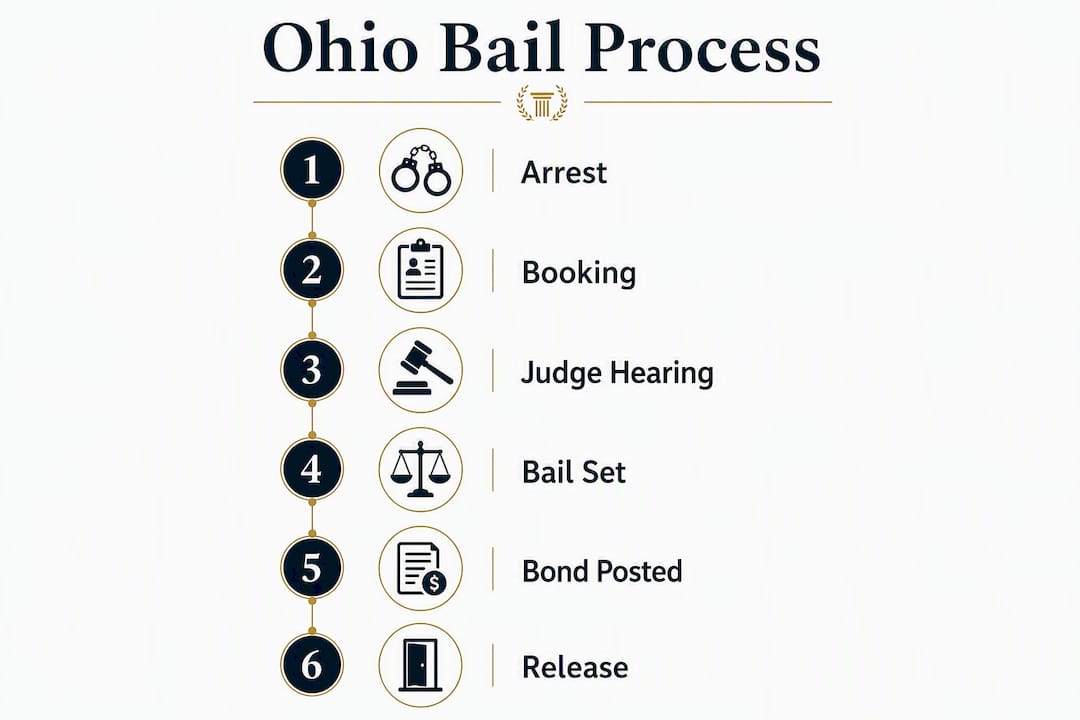
Knowing the sequence helps you plan. Here is what typically happens after a domestic violence arrest in Ohio:
Arrest and booking. Police take the defendant into custody, complete an arrest report and affidavit, and transport them to the county jail or local holding facility. The affidavit documents the officer’s observations, including any injuries, weapons, and statements made at the scene. Judges review this document when setting bail.
Initial hold. The defendant is booked and held. At this stage, no bail has been set for cases that require a judge appearance under §2919.251. A bail schedule may apply to minor misdemeanor charges that do not trigger the statute, but domestic violence cases frequently fall outside standard schedule release.
Initial appearance or arraignment. ORC §2937.011(J)(1) requires that a defendant who has not been released be brought before a judicial officer no later than the second court day following arrest. In practice, this means weekends and court holidays extend the wait. A defendant arrested on a Friday evening may not see a judge until Monday or Tuesday.
Bail hearing. For cases with §2919.251 triggers, bail is set at this appearance. The judge reviews the affidavit, the defendant’s criminal history, and any information presented by the prosecutor or defense attorney. Bail conditions are announced at this point.
Bond posting. Once the judge sets the amount and conditions, the defendant or family can post bail. A licensed bail agent can post a surety bond directly with the jail, often within hours of the judge’s order. See the Ohio bail bonds release process for a step-by-step breakdown of what happens at the jail.
Release and pretrial compliance. After posting, the defendant is released subject to all conditions the judge imposed. Compliance begins immediately, not at the next court date.
County variability is real. Franklin County, Hamilton County, and Summit County each operate on different schedules and have different local practices for DV arraignments. Some local bail schedules treat domestic violence and assault as exceptions where judges must set bail individually rather than relying on a published amount. Always confirm the specific court’s schedule through the county clerk’s office.
Financial bail is only part of the picture. In domestic violence cases, the conditions attached to release often affect daily life more than the dollar amount.
No-contact and stay-away orders are the most common. Under Ohio practice, no-contact bond terms typically prohibit all direct and indirect communication with the alleged victim: phone calls, texts, emails, social media messages, and contact through third parties including mutual friends or children. Stay-away provisions often extend to the victim’s home, workplace, and school. Returning to a shared residence, even to retrieve personal belongings, can constitute a violation.
Indirect contact violations are among the most common reasons defendants lose their bond after a domestic violence arrest. A text sent through a friend, a comment on a shared social media post, or a message passed through a child counts as contact under most Ohio bond orders.
Firearm surrender and weapon restrictions follow almost automatically in cases involving a deadly weapon or a protection order. The court may order the defendant to surrender all firearms to law enforcement or a licensed dealer within a set timeframe. Federal law under 18 U.S.C. § 922(g)(9) also prohibits firearm possession for anyone convicted of a qualifying domestic violence misdemeanor, so the stakes extend beyond the bond condition itself.
Prohibition on returning to the shared home is standard when the alleged victim still lives there. If you need to retrieve medication, work equipment, or essential documents, the correct path is a formal property retrieval request through the court, often with a law enforcement standby. Private arrangements with the alleged victim do not override court orders.
Electronic monitoring, GPS tracking, substance testing, and curfews are less universal but appear regularly in cases involving prior violations, substance abuse history, or high-risk indicators. GPS monitoring requires the defendant to wear a device and stay within approved geographic boundaries. Substance testing may be random and can be required as a condition of continued release.
Civil and criminal protection orders run parallel to bond conditions. Ohio courts issue criminal temporary protection orders (TPOs) under ORC §2919.26 at arraignment. A separate civil protection order (CPO) may also be in place or pending. Violating either carries its own criminal exposure under ORC §2919.27, separate from the bond violation itself.
Pro Tip: If the alleged victim contacts you first, do not respond. Preserve every incoming message and hand it to your attorney. Responding, even to say “stop contacting me,” can be treated as a violation of your no-contact condition.
Understanding why bail conditions matter before you leave the jail is one of the most practical steps you can take.
The dollar amount of bail in a domestic violence case is not fixed. ORC §2937.011 directs courts to weigh four primary factors when setting financial conditions: risk of non-appearance, public safety risk, seriousness of the offense, and the defendant’s prior criminal record.
Offense classification under ORC §2919.25 directly affects how seriously the court views the case. A first-offense domestic violence charge is typically a first-degree misdemeanor. A second offense, or a first offense involving a pregnant victim, elevates to a fourth-degree felony. Repeat felony charges carry even higher classifications. The higher the grade, the more financial exposure the defendant faces at bail.
Options for securing release in Ohio:
National practice data indicates that felony assault bail amounts vary widely depending on case facts and history, with no fixed starting amount applicable to all situations. For a detailed breakdown of how felony bail amounts are calculated in Ohio, the factors courts weigh are consistent with the §2937.011 framework.
Pro Tip: Ask the jail or court clerk whether a local bail schedule applies to your charge. Some Ohio counties publish misdemeanor schedules online. For domestic violence charges, however, assume a judge will set the amount individually and plan accordingly.
Speed matters. Every hour in custody is an hour away from work, family, and the ability to prepare a defense. Here is the practical sequence to follow.
Step 1: Get the booking information. You need the defendant’s full legal name, booking number, arresting agency, the specific charges filed, and the court where the case is assigned. The jail’s intake desk can provide most of this. Without the booking number, a bail agent cannot begin the process.
Step 2: Contact a licensed bail agent and an attorney simultaneously. A licensed Ohio bail agent can begin preparing paperwork and coordinating with the jail before the judge even sets the amount. A criminal defense attorney, such as those at Granite Criminal Defense, can appear at the arraignment to advocate for a lower bail amount and narrower conditions. These are two separate roles. The bail agent handles the financial transaction; the attorney handles the legal defense.
Step 3: Attend the bail hearing. If the defendant has an attorney present at arraignment, the attorney can present community ties, employment, and other stabilizing factors that may reduce the bail amount or loosen conditions. Without representation, the prosecutor’s version of events goes largely unchallenged.
Step 4: Post the bond. Once the judge sets the amount, a licensed bail agent can post a surety bond directly with the jail. Caesarbailbonds offers 24/7 mobile service, meaning an agent comes to the jail rather than requiring the family to navigate the process alone. Payment plans are available for qualifying clients (company-sourced).
Step 5: Confirm release conditions before leaving. Before the defendant walks out, confirm every condition in writing. Get a copy of the bond order and the protection order if one was issued. Misunderstanding a condition is not a defense to a violation.
Pro Tip: Bring a valid government-issued photo ID, the booking number, and your payment method when heading to the jail or courthouse. If you are posting on behalf of a family member, some facilities require proof of relationship. Call ahead to confirm what the specific jail requires.
Common mistakes at this stage, including signing paperwork without reading it or assuming verbal agreements with jail staff are binding, are covered in detail in the felony bail process mistakes guide.
Violating a bond condition after a domestic violence arrest in Ohio carries consequences that move fast and hit hard.
Immediate consequences of a violation:
A bond violation in a domestic violence case does not just affect your current case. It signals to the court that you are a compliance risk, which can affect every future bail decision in the same proceeding.
How violations are documented. Police reports, phone records, social media activity, and witness statements are all used as evidence of contact violations. Even a “like” on the alleged victim’s social media post has been cited in violation proceedings. Preserve any incoming messages from the protected party and bring them to your attorney without responding.
Seeking a modification. If you need a narrow exception, such as a scheduled parenting exchange or a one-time property retrieval, the correct path is a formal motion to modify bond conditions filed through the court. Private agreements between you and the alleged victim carry no legal weight and do not protect you from a violation finding. The bail reinstatement process in Ohio explains how to seek reinstatement or modification when a bond is at risk.
Understanding the full scope of bail forfeiture consequences before any alleged violation occurs gives you the clearest picture of what is at stake financially and legally.
Walking into an arraignment unprepared is one of the most avoidable mistakes in this process.
What to bring:
Why attorney representation at arraignment matters. The arraignment is the first opportunity to challenge the bail amount and conditions on the record. An attorney can present mitigating factors, object to overly broad no-contact language, and request specific accommodations such as a video appearance under §2919.251(D)(2). Without counsel, defendants often accept conditions they do not fully understand and that are difficult to modify later.
Common mistakes to avoid:
Pro Tip: If the court offers a video appearance option under ORC §2919.251(D)(2) for a misdemeanor charge, discuss with your attorney whether accepting it speeds release or limits your ability to present mitigating information effectively. The answer depends on your specific facts.
The following section contains company-sourced information about Caesar Bail Bonds’ services and capabilities.
Caesarbailbonds is a licensed Ohio bail bond agency providing 24/7 mobile service across the state, including Columbus, Cincinnati, Dayton, Akron, and Canton. Here is what a licensed agent does in a domestic violence case:
Fees charged by a licensed bail bond agency are non-refundable and based on a percentage of the total bond amount. Caesarbailbonds does not provide legal advice or legal representation. For defense strategy, order modification, and case preparation, clients are directed to retain qualified criminal defense counsel.
Caesarbailbonds agents understand the mandatory judge-appearance requirement under §2919.251 and the typical delays that come with domestic violence cases, particularly over weekends and holidays. The agency’s role is to be ready the moment a judge sets the amount, so release happens as quickly as the court allows.
Ohio domestic violence bail requires a mandatory judge appearance under ORC §2919.251 when statutory triggers are present, and release always comes with strict conditions that begin the moment you walk out.
| Point | Details |
|---|---|
| ORC §2919.251 triggers a judge appearance | Five specific risk factors force in-court bail-setting; assume stricter conditions in every DV case. |
| Bail includes conditions, not just money | Expect no-contact orders, weapon prohibitions, and possible monitoring before release is granted. |
| Three main posting options | Own recognizance, 10% cash deposit (90% returned on compliance), or surety bond through a licensed agent. |
| Violations carry immediate consequences | Bond revocation, forfeiture, and new criminal charges under ORC §2919.27 can follow a single contact. |
| Caesarbailbonds provides 24/7 mobile service | Licensed agents post surety bonds across Ohio and coordinate directly with jails to speed release after a judge sets bail. |
Domestic violence cases move differently than most arrests we handle. The mandatory judge-appearance requirement under §2919.251 means families often wait longer than they expect, especially when an arrest happens late on a Thursday or over a holiday weekend. That wait is real and frustrating. Our role is to be ready the moment the judge sets a number, so we can post the bond and get your loved one home as quickly as the court allows.
What we see consistently: defendants who try to manage the situation on their own, without an attorney and without understanding the no-contact order they signed, end up back in custody within days. Private agreements with the alleged victim do not change what the court order says. We always tell clients the same thing: follow every condition exactly as written, preserve any incoming messages without responding, and get a defense attorney working on your case before the next court date.
Our job is to handle the bond. Your attorney’s job is to handle the defense. Those two roles work best when they run in parallel, not in sequence.
When a judge sets bail after a domestic violence arrest in Ohio, the clock starts. Caesarbailbonds provides 24/7 mobile bail bond service across Ohio, covering felony and misdemeanor charges, with licensed agents who come directly to the jail to handle paperwork and post the surety bond on your behalf.

When you call, have the booking number, the arresting agency, and the charge details ready. An agent will confirm the bond amount once set, explain the fee structure clearly, and walk you through the indemnity agreement before anything is signed. Payment plans are available for qualifying clients. Caesarbailbonds does not provide legal representation; for defense and order modification, we refer clients to qualified Ohio criminal defense attorneys.
Serving Columbus, Cincinnati, Dayton, Akron, Canton, and communities across Ohio, Caesarbailbonds is available around the clock because arrests do not follow business hours. Start the process now through the online bail bond application or reach a licensed agent directly through the 24/7 Ohio bail bond help line.
This article provides general information about Ohio bail procedures and is not legal advice. Confirm current statutes and local court practices with a licensed Ohio attorney or the relevant court clerk.
If you are in need of a bail bonds service in OH, look no further than Caesar Bail Bonds LLC. For a great service in Lorain, Elyria, North Ridgeville, Avon Lake, Oberlin, Sandusky, Vermillion, Toledo, Port Clinton, Greene County, Columbus as well as in the entire state of Ohio call on Caesar Bail Bonds LLC.
Get Quote !
"*" indicates required fields