
Menu

Bail forfeiture is defined as a court’s declaration that the full bail amount is immediately owed because a defendant violated release conditions, most often by missing a scheduled court date. To understand bail forfeiture consequences fully, you need to know that the financial and legal fallout extends far beyond losing the money posted. Defendants face new criminal charges, and cosigners risk losing their homes, cars, and wages. Ohio courts follow a structured process with strict deadlines, and missing those deadlines turns a recoverable situation into a permanent financial judgment. Knowing how this process works gives you real options.
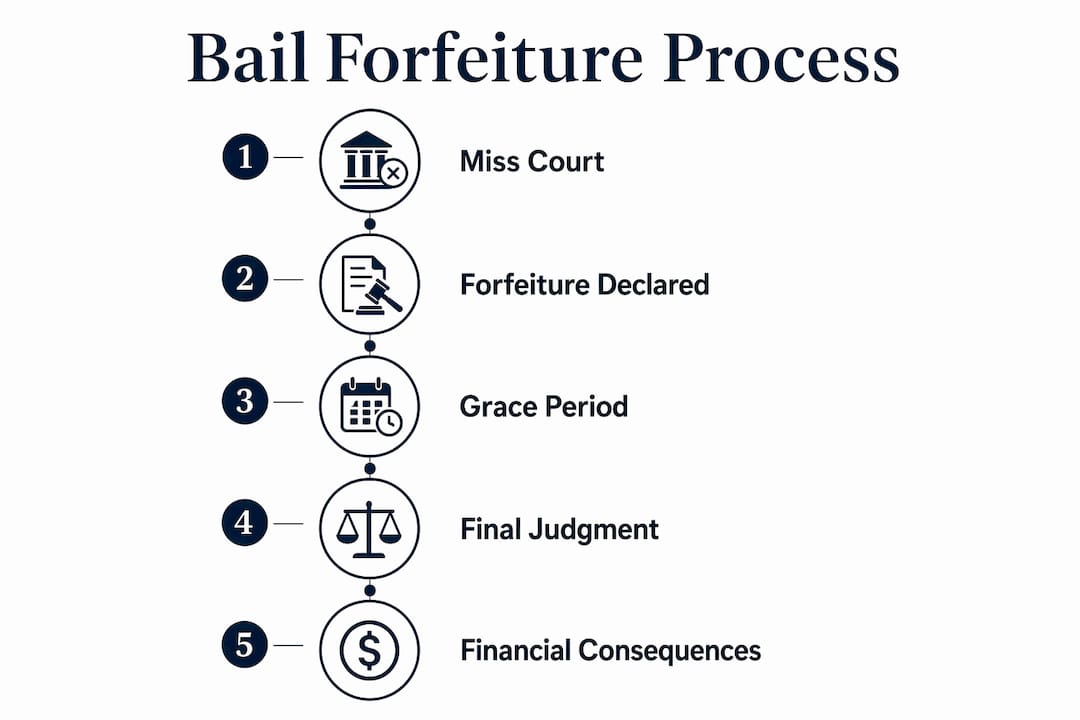
Bail forfeiture begins the moment a defendant fails to appear in court or violates a condition of release. The judge calls the case, notes the absence, and issues a forfeiture declaration on the record. That declaration is not yet a final judgment. It is the starting point of a legal process that gives defendants and bail agents a window to act.
Ohio courts follow these steps after a missed appearance:
The distinction between a forfeiture declaration and a final judgment matters enormously. Many people treat the declaration as the end of the road and stop acting. That mistake costs them the grace period entirely.
Pro Tip: Mark the exact date you receive the forfeiture notice and count forward to identify your jurisdiction’s grace period deadline. Missing that date by even one day can eliminate your right to contest the forfeiture.

Bail agents play an active role during the grace period. They have legal authority to locate and return defendants to custody, which can stop or reduce the forfeiture. Working with your bail agent immediately after a missed court date is one of the fastest ways to protect everyone involved. Learn more about bail conditions for defendants to understand what triggers this process in the first place.
The financial impact of forfeiture hits defendants and cosigners differently, but both face serious exposure. Understanding the difference between cash bail and a bail bond premium is the starting point.
When you pay cash bail directly to the court, that full amount is at risk of forfeiture. When you use a bail bond company, you pay a non-refundable premium, typically 10% of the bond amount. That premium is gone regardless of outcome. The bail bond company then owes the court the full bond amount if forfeiture is declared.
Here is where cosigners face their greatest risk:
Cosigners often underestimate the seriousness of their joint and several liability, which encompasses the entire bond amount plus costs and fees. Signing a bail bond indemnity agreement is a legally binding financial commitment, not a formality.
The financial mechanics of bail bonds are worth understanding before you sign anything. Review how bail and bond differ to clarify your obligations before a forfeiture situation arises.
Bail forfeiture does not end your legal exposure. Missing a court date while on bail is a separate criminal offense in Ohio and under federal law. The new charges stack on top of your original case and make everything harder.
The criminal consequences of failure to appear include:
New charges compound the original case in a practical way too. Your attorney now has to defend two matters simultaneously, which increases legal costs and reduces negotiating leverage. Avoiding felony bail process mistakes from the start is far less costly than managing the fallout from a forfeiture.
Receiving a forfeiture notice is not the end of your options. Ohio law provides remedies, but they require fast, organized action. Legal remedies including remission or set-aside vary by jurisdiction and depend heavily on timing, notice adequacy, and whether the defendant returns to custody.
Follow these steps immediately after receiving a forfeiture notice:
Pro Tip: Never ignore a forfeiture notice hoping it resolves itself. Misunderstandings about forfeiture timing cause many people to miss critical remedial deadlines, turning a manageable situation into an uncontrollable financial judgment.
Common pitfalls to avoid include waiting for your attorney to act without following up yourself, failing to appear at any subsequent hearings, and assuming the bail company will handle everything without your involvement. The bail agent, the attorney, and you all need to work together within the same deadline window. For a practical checklist on rapid action steps, review the bail bond assistance checklist that outlines what to do when time is short.
Bail forfeiture in Ohio triggers immediate financial liability, new criminal charges, and strict deadlines that determine whether you can recover or face permanent judgment.
| Point | Details |
|---|---|
| Grace period is critical | Ohio courts allow 30–180 days to act before a final forfeiture judgment enters. |
| Cosigners face full liability | Joint and several liability means one cosigner can owe the entire bond amount plus interest. |
| New charges stack fast | Missing court while on bail adds up to two or more years of federal imprisonment exposure. |
| Return to custody helps | Returning the defendant during the grace period can reduce or cancel the forfeiture amount. |
| No tax deductions apply | Courts deny tax relief for forfeiture losses, making every dollar lost purely out of pocket. |
The single most damaging pattern I see in Ohio bail forfeiture cases is inaction during the grace period. People receive the notice, feel overwhelmed, and wait. By the time they engage an attorney or call their bail agent, the deadline has passed and the final judgment has entered. At that point, the options shrink to near zero.
The second pattern is cosigner complacency. Cosigners often believe they are signing a formality. They are not. They are accepting full financial responsibility for another person’s court compliance. I have seen cosigners lose vehicles and face wage garnishment over bonds they thought were someone else’s problem. If you are considering cosigning a bail bond, read the indemnity agreement carefully and ask the bail agent to walk you through every obligation before you sign.
Working constructively with your bail agent is genuinely useful, not just procedurally. Experienced bail agents know the local courts, know the clerks, and know which motions have the best chance of success in a given jurisdiction. They are not adversaries in a forfeiture situation. They want the bond resolved as much as you do. Treat them as partners and communicate openly from the first missed court date.
Finally, get legal counsel early. A criminal defense attorney who understands Ohio bail law can file a motion to set aside the forfeiture, negotiate remission, and protect your record from compounding charges. The cost of that counsel is almost always less than the cost of a final forfeiture judgment.
— Anthony
Facing a bail forfeiture notice in Ohio is a serious situation, and you should not handle it alone. Caesarbailbonds provides 24/7 mobile bail bond services across Ohio, including Columbus, Cincinnati, Dayton, Akron, and Canton. Our licensed agents come directly to you, whether you are at home or at the jail, and guide you through every step of the process.

When a forfeiture notice arrives, time is the most valuable resource you have. Caesarbailbonds agents understand Ohio court procedures and work quickly to help defendants and cosigners protect their interests. Whether you need Ohio bail bond help for an active case or guidance after a missed court date, our team is ready around the clock. Call us now to speak with a licensed Ohio bail agent who can help you act before your deadline passes.
Bail forfeiture is a court’s declaration that the full bail amount is owed because the defendant missed a court date or violated release conditions. The court issues a forfeiture declaration and begins a grace period before entering a final judgment.
A bail forfeiture judgment is the final court order entered after the grace period expires without corrective action. Once entered, it carries the same collection power as any civil money judgment, including liens and wage garnishment.
Grace periods range from 30 to 180 days depending on the jurisdiction. Ohio courts use this window to allow defendants to return to custody or for parties to file motions to set aside the forfeiture.
Yes. Courts can grant remission or set aside a forfeiture if the defendant returns to custody during the grace period or if documented evidence shows a valid reason for the missed appearance. Filing the correct motion before the deadline is required.
Cosigners face joint and several liability for the full bond amount. The bail company can pursue any cosigner for the entire debt, plus accrued interest between 7% and 10% annually, and can seize pledged collateral or pursue wage garnishment if the debt goes unpaid.
If you are in need of a bail bonds service in OH, look no further than Caesar Bail Bonds LLC. For a great service in Lorain, Elyria, North Ridgeville, Avon Lake, Oberlin, Sandusky, Vermillion, Toledo, Port Clinton, Greene County, Columbus as well as in the entire state of Ohio call on Caesar Bail Bonds LLC.
Get Quote !
"*" indicates required fields