How Courts Determine Bail: A Clear 2026 Guide
Courts set bail to secure a defendant’s appearance at future hearings, not to punish before a verdict. The role of court in bail determination goes well beyond picking a dollar amount. Judges weigh flight risk and public safety against a defendant’s constitutional rights, then choose the least restrictive conditions that still protect the community. No two cases produce the same result, because the law requires an individualized assessment rather than a fixed formula.
- Bail’s core purpose is to guarantee court appearances, not to serve as pre-trial punishment
- Courts assess flight risk, offense severity, criminal history, and danger to the community
- Judges exercise discretion guided by statutes like the Bail Reform Act of 1984 and the Eighth Amendment
- Release can be monetary or nonmonetary, depending on the defendant’s profile and case facts
- Every bail decision must reflect the specific circumstances of the individual before the court
Who sets bail, and when does it happen?
Judges and magistrates are the sole decision-makers on bail. That authority is not shared with police or prosecutors, though prosecutors do present arguments that influence the outcome. The bail hearing process typically begins at a defendant’s first appearance or arraignment, which usually occurs within 24–72 hours of arrest depending on the jurisdiction.
- Judges preside over felony cases and more serious matters, often in a formal courtroom setting
- Magistrates frequently handle initial appearances, especially in federal court and many state systems
- First appearance is the earliest point at which bail can be addressed; arraignment may follow shortly after
- Bail reviews are available later if circumstances change, such as new evidence or prolonged case delays
- Jurisdictional rules vary widely: some states allow bail schedules that set amounts by offense type, while others require a full hearing before any amount is set
- Case urgency matters: violent or high-profile offenses often trigger immediate detention hearings rather than routine bail-setting
Pro Tip: If you or a loved one is waiting for a first appearance, having an attorney present at that hearing can make a measurable difference in the bail outcome.
The judicial role in bail is not passive. Judges must actively weigh evidence, hear arguments from both sides, and document their reasoning, especially when ordering detention.

What types of bail conditions can a court impose?
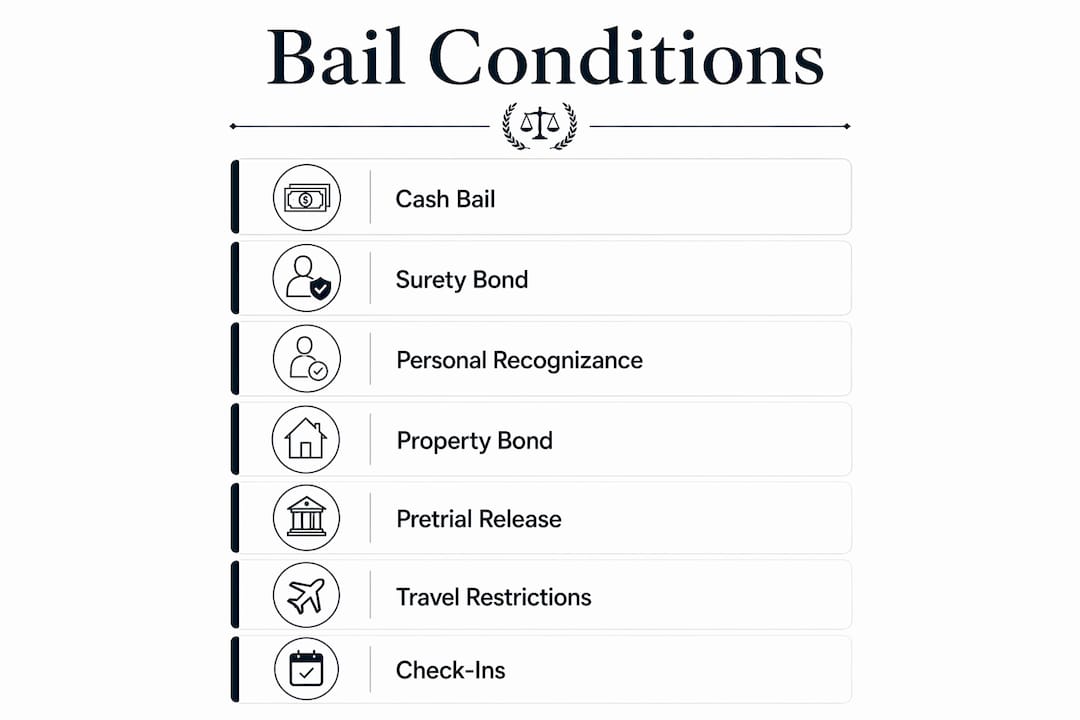
Courts have a broad menu of release options, and the choice depends on how much risk the defendant presents. Monetary bail is the most familiar form, but it is far from the only one.
- Release on recognizance (ROR): The defendant signs a written promise to appear, with no money required. Courts favor this when risk of flight is low and the offense is not serious
- Unsecured appearance bond: The defendant owes a set amount only if they fail to appear, with nothing paid upfront
- Cash bail: The full amount must be deposited with the court before release; it is refunded at case conclusion if all appearances are met
- Surety bond: A licensed bail bond agent posts the full bail amount on the defendant’s behalf, typically for a nonrefundable fee
- Property bond: Real estate or other assets serve as collateral in place of cash
- Conditional release: The court attaches specific behavioral requirements, such as travel restrictions, curfews, electronic monitoring, or no-contact orders with alleged victims
- Third-party custody: A responsible adult, often a family member, agrees to supervise the defendant and ensure court appearances
- Supervised release: A pretrial services officer monitors the defendant’s compliance with all conditions
Courts tailor bail types to the individual. A first-time, low-risk defendant charged with a minor offense may walk out on ROR, while someone with a history of failures to appear will likely face a secured bond with strict conditions attached.
Key factors courts consider when deciding bail
The court’s decision on bail rests on a defined set of factors, most of which trace back to the Bail Reform Act of 1984 and parallel state statutes. Judges do not guess. They apply these criteria to the facts in front of them.
- Flight risk: Prior failures to appear, lack of community ties, or access to resources that make fleeing feasible all increase the likelihood of a higher bail or detention
- Offense severity: Charges involving violence, weapons, drugs, or terrorism carry a statutory presumption toward detention in federal court
- Criminal history: A record of prior convictions, especially for similar offenses, weighs against lenient bail terms
- Danger to the community: If releasing the defendant poses a credible threat to victims, witnesses, or the public, the court can deny bail entirely after a hearing
- Family ties and community roots: Stable employment, long-term residence, and close family connections all support a lower bail amount
- Financial resources: Courts must consider what a defendant can actually afford. Setting bail at an amount the defendant cannot pay, solely to detain them, violates federal statute
- Past court appearance history: A clean record of showing up to prior hearings is one of the strongest arguments for release on recognizance
- Weight of the evidence: While not the primary factor, the strength of the prosecution’s case can influence how courts set bail
- Bail schedules vs. individualized review: Many jurisdictions publish bail schedules that assign amounts by charge. Reform movements push courts toward individualized assessments that account for the full picture rather than a static chart
For a deeper look at how judges weigh these criteria, the factors judges consider vary by state but follow a consistent federal framework.
What happens after bail is set?
Once the court announces bail, the clock starts. The defendant stays in custody until the bail conditions are satisfied, so speed matters.
- Posting bail: A defendant or family member can pay cash directly to the court, or work with a licensed bail bond agent who posts the full amount for a fee
- Condition compliance: Any nonmonetary conditions, such as a curfew, travel ban, or check-in requirement, take effect immediately upon release
- Monitoring: Electronic ankle monitors, regular check-ins with pretrial services, and drug testing are common enforcement tools
- Violation consequences: Missing a court date triggers an automatic warrant, forfeiture of any posted bail, and possible new criminal charges for failure to appear
- Bail revocation: If a defendant violates conditions while released, the court can revoke bail and order immediate detention
- Bail review motions: Defense attorneys can file a motion requesting a bail reduction or modification if circumstances change, such as a prolonged delay in trial or a change in the defendant’s health or employment situation
- Prosecutor’s role: Prosecutors monitor compliance and can petition the court to revoke or increase bail if new information surfaces. For a full breakdown of how prosecutors engage, see Caesarbailbonds’s guide on the prosecutor’s role in Ohio bail hearings
Understanding why bail conditions matter is just as important as knowing how they are set. A single missed check-in can undo everything the court agreed to at the hearing.
Legal safeguards that protect you during a bail hearing
The bail hearing process carries real constitutional weight. Courts are not free to set bail arbitrarily, and defendants have enforceable rights at every step.
- Right to counsel: Defendants have the right to an attorney at bail hearings. A lawyer can present evidence of community ties, employment, and other factors that support release
- Eighth Amendment limits: The Constitution prohibits excessive bail, meaning bail cannot be set so high that it functions as punishment rather than a guarantee of appearance
- Presumption of release: Under the Bail Reform Act of 1984, the default is release. The government must prove, at a detention hearing, that no set of conditions will reasonably assure appearance and community safety
- Least restrictive standard: Courts are legally required to impose the least restrictive conditions necessary, not the most convenient or the most punitive
- Financial ability: A court cannot intentionally set bail at a level the defendant cannot meet just to keep them detained. If a defendant informs the court they cannot make bail, the judge must explain on the record why that financial requirement is necessary
- Written findings: Federal rules require courts to state their reasons for release or detention orders in writing or on the record, creating a basis for appeal
- Appeal rights: A defendant can appeal a bail decision to a higher court. Defense attorneys regularly use this mechanism when they believe the original order was excessive or legally flawed
- Detention as the exception: Pretrial detention is reserved for cases where the government proves, by clear and convincing evidence for dangerousness or by a preponderance for flight risk, that no conditions will work
Pro Tip: If bail feels unaffordable after the hearing, ask your attorney immediately about filing a bail review motion. Courts can and do reduce bail when the defense presents new information about the defendant’s financial situation or community ties.
Reform efforts across the country continue to push courts toward totality-of-circumstances reviews rather than relying on static bail schedules, with the goal of keeping pretrial detention a last resort rather than a default.
How Caesarbailbonds can help after bail is set

Once the court sets bail, you need to act fast. Caesarbailbonds provides 24/7 licensed bail bond services across Ohio, including Columbus, Cincinnati, Dayton, Akron, and Canton. Our agents come directly to you, whether you are at home or at the jail, so you are not navigating this alone. We handle felony and misdemeanor cases, transfer bail across jurisdictions, and guide you through every step until your loved one is home.
Start with our Ohio bail bonds guide to understand the full release process, or connect with a licensed bail agent near you right now. We are ready when you need us.
Key Takeaways
Courts determine bail through individualized judicial assessments that balance a defendant’s right to pretrial liberty against the community’s need for safety and the court’s need for the defendant’s appearance.
| Point |
Details |
| Bail is not punishment |
Courts set bail to secure court appearances; any amount must be refundable and constitutionally reasonable. |
| Judges weigh multiple factors |
Flight risk, offense severity, criminal history, community ties, and financial resources all shape the final bail decision. |
| Least restrictive conditions apply |
By law, courts must choose the minimum conditions necessary, not the strictest available. |
| Defendants have enforceable rights |
The Eighth Amendment, right to counsel, and written-findings requirements protect defendants throughout the bail hearing process. |
| Bail can be reviewed and modified |
Defense attorneys can file motions to reduce or change bail if circumstances shift before trial. |
Recommended