How Charges Impact Your Bail Amount: A Clear Guide
The type and severity of criminal charges you face are the single strongest predictor of your bail amount. As a general rule, felony charges carry bail that runs 5 to 10 times higher than what courts set for misdemeanors. That gap is not arbitrary. Courts treat charge severity as a proxy for flight risk and public safety concern, which means a felony arrest puts you in a fundamentally different category from the moment you are booked.
Here is what the charges against you directly affect:
- Bail amount: More serious charges trigger higher bail schedules, often by a large multiple.
- Eligibility for release: Certain felony charges, particularly violent offenses, drug trafficking, or firearms violations, can result in bail being denied entirely.
- Conditions of release: Felony defendants frequently face additional restrictions such as electronic monitoring, travel limits, or no-contact orders.
- Prior record weight: Courts combine your charges with your criminal history, and a prior record alongside serious charges can push bail well beyond standard schedule amounts.
- Flight risk assessment: The potential sentence attached to your charges directly influences how likely a judge believes you are to appear for trial.
Bail is not designed to punish you. Its legal purpose is to guarantee you return to court. Understanding that distinction matters because it gives you and your attorney a framework for arguing that a lower amount still achieves that goal.
What bail actually is and how it gets set
Bail is a financial guarantee. You pay a set amount, or arrange for a bond, and the court releases you until your trial date. If you appear as required, you get the money back. If you skip court, you forfeit it.
Most people encounter bail through one of three forms:
- Secured bail: You pay cash or use a bail bond agent to post the full amount. This is the most common type for felony charges.
- Unsecured bail: You sign a promise to pay a specified amount if you fail to appear, but you do not pay upfront. Courts use this for lower-risk defendants.
- Personal recognizance (PR) release: No money changes hands. The judge releases you on your word that you will show up. PR release is most common for minor, nonviolent misdemeanors with no prior record.
Bail hearings typically happen at your first court appearance, which in most jurisdictions occurs within 24–72 hours of arrest. Many jails post a bail schedule that allows release before you ever see a judge, but those schedules are based on the charges listed at booking. If police charged you with a felony, even one likely to be reduced later, the bail schedule reflects the felony amount.
A common misconception is that bail is fixed once set. Judges can raise or lower bail at subsequent hearings, and your attorney can formally request a reduction by presenting evidence of your community ties, employment, and financial situation.
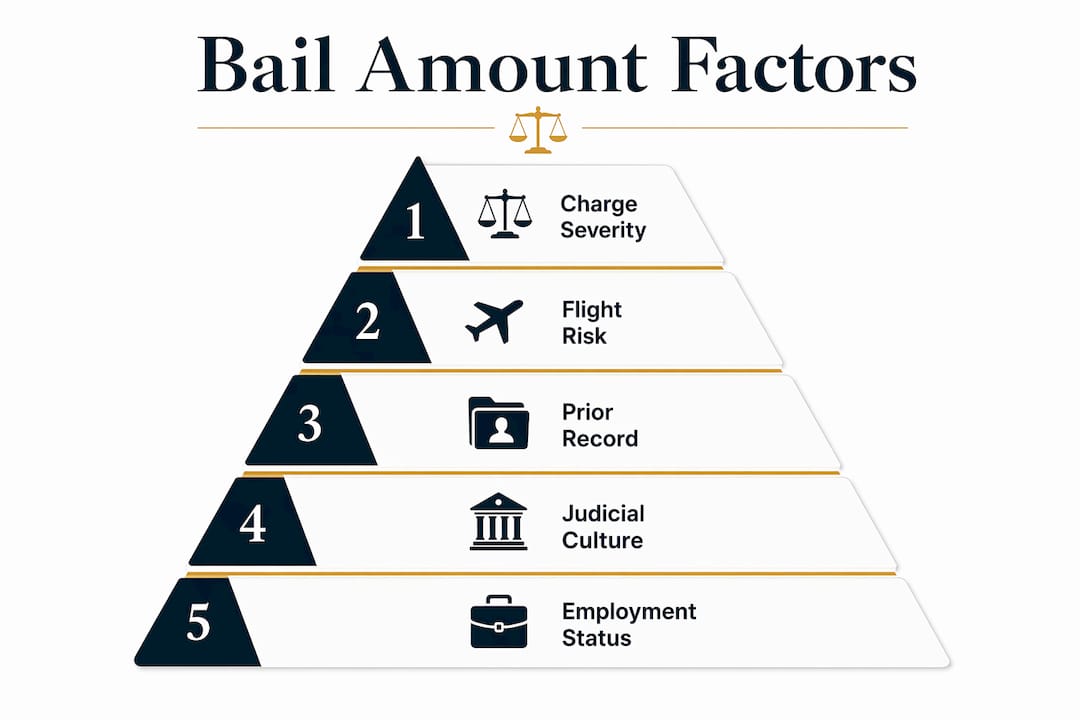
What factors determine how much bail you owe
Charge severity is the starting point, but judges weigh a full picture before settling on a number. Courts consider multiple factors beyond the charges themselves, including community ties, employment, and court appearance history, which means two defendants facing identical charges can walk out with very different bail amounts.
The core factors courts examine:
- Severity and classification of the offense: Felonies, especially violent or drug-related ones, anchor the bail amount at a higher baseline.
- Prior criminal record: A history of convictions signals higher risk. Prior failures to appear in court carry particular weight and can dramatically increase bail.
- Community ties: Stable employment, long-term residence, family in the area, and local roots all argue for lower bail or nonfinancial release.
- Flight risk indicators: Possession of a passport, recent travel abroad, lack of local ties, or a pending sentence that creates strong incentive to flee all push bail higher.
- Danger to the public: Charges involving violence, weapons, or threats to specific victims lead judges to set higher bail or impose strict conditions.
- Financial ability to pay: Many states now require judges to consider whether a defendant can realistically post bail. Defendants with private legal counsel are up to seven times more likely to obtain bail than those without representation, which underscores how much the quality of your legal team shapes the outcome.
Local judicial culture also plays a role. Counties with higher unemployment rates tend to set significantly higher bail amounts, reflecting how socioeconomic context shapes decisions beyond the facts of any individual case.
Pro Tip: If you have stable employment, a long residential history, and no prior failures to appear, make sure your attorney presents that evidence at your bail hearing. Judges have discretion, and documented community ties can move the number down.
How felony vs. misdemeanor charges change your bail
The difference between a felony and a misdemeanor charge is not just a legal label. It translates directly into how much money you need to get out of jail.
- Felony bail is typically 5 to 10 times higher than bail for a comparable misdemeanor, according to standard bail schedules.
- Violent felonies, such as aggravated assault, robbery, or homicide, often carry bail in the tens of thousands to hundreds of thousands of dollars, or no bail at all.
- Nonviolent felonies like drug possession or property crimes typically fall in a lower range than violent offenses, but still far above misdemeanor amounts.
- Misdemeanor bail for a first-time, nonviolent offense can be as low as a few hundred dollars in many jurisdictions.
- Charge reduction matters: if your attorney negotiates a felony down to a misdemeanor before or at arraignment, the bail schedule amount drops accordingly.
The charge on your arrest paperwork controls the bail schedule, not what the charge may eventually become. Police routinely book defendants on the most serious charge the facts can support. That means you could be held on a felony bail amount for a charge that prosecutors later reduce or drop entirely. Understanding the Ohio misdemeanor bail process versus felony procedures helps you know what to expect at each stage.
Violent charges carry an additional layer of scrutiny. Judges treat them as evidence of danger to the community, which justifies both higher amounts and stricter conditions. A defendant charged with simple drug possession faces a very different bail conversation than one charged with armed robbery, even if both are first-time offenders.

How flight risk and special circumstances affect your eligibility
Flight risk is not just a factor in setting the bail amount. In serious cases, it can eliminate bail entirely.
- How flight risk is assessed: Judges look at the potential sentence you face, your ties to the community, your financial resources, travel history, and whether you have any prior failures to appear. A defendant facing a 20-year sentence has a much stronger incentive to flee than one facing probation.
- Probation or parole status: If you were on probation or parole when arrested, your supervising officer can file a detainer. A detainer means you cannot bail out until a judge removes it, regardless of the bail amount set on the new charge.
- Victim impact and community concerns: In cases involving domestic violence, stalking, or threats, prosecutors and victims can present statements arguing that release poses a direct danger. Judges weigh these heavily when deciding whether to set bail at all.
- Prior failures to appear: A documented history of skipping court dates is one of the strongest arguments for denying bail or setting it at an amount designed to be unaffordable.
- Nonfinancial alternatives: For defendants who pose low flight risk but cannot afford money bail, courts can order electronic monitoring, regular check-ins with pretrial services, travel restrictions, or surrender of a passport.
Bail denial is most common for capital offenses, violent felonies with strong evidence, defendants with active warrants in other jurisdictions, and cases where the court finds no set of conditions will guarantee public safety. If you are facing a no-bail hold, a felony defense attorney can request a detention hearing and challenge the court’s findings directly.

Why bail amounts vary so much from state to state
Two defendants charged with the same offense in different states can face bail amounts that differ by tens of thousands of dollars. That is not a mistake. It reflects genuinely different legal frameworks and local practices.
- Bail schedules vary widely: Some counties publish detailed schedules that set specific dollar amounts for each charge. Others give judges broad discretion with only general guidelines. Average bail amounts have ranged from under $10,000 to over $100,000 depending on the county.
- Some states limit or eliminate money bail: New Jersey, Illinois, and Washington, D.C. have moved away from cash bail systems, replacing them with risk-based assessments that focus on flight risk and public safety rather than ability to pay.
- Judicial elections and local politics: Research shows that the partisan affiliation of local officials and the politicization of judicial offices correlate with bail-setting practices, meaning the same charge can carry different bail in a conservative versus a progressive jurisdiction.
- Bail reform trends: Many states are actively revising their bail laws to reduce reliance on financial conditions, particularly for nonviolent offenses. Ohio has its own procedures and timelines that differ from neighboring states.
- Local socioeconomic context: As noted earlier, counties with higher unemployment tend to set higher bail, a pattern that reflects local judicial culture rather than the facts of individual cases.
Knowing the specific rules in your jurisdiction is not optional. A bail amount that seems standard in one Ohio county can be significantly different in another. The role of prosecutors in bail hearings also varies by county, and their recommendations carry real weight with judges.
What the Constitution says about bail and your charges
The Eighth Amendment to the U.S. Constitution prohibits excessive bail. That protection is real, but its practical application is narrower than many defendants expect.
- The constitutional standard: Bail is excessive when it is set far higher than necessary to ensure your court appearance and protect public safety. The federal bail statute requires courts to impose the least restrictive conditions necessary to meet those two goals.
- Judges cannot use bail to punish: Setting bail at an amount designed to keep you in jail, rather than to secure your appearance, violates the law. Courts must set bail at the lowest amount necessary to reasonably assure your return to court.
- Financial conditions and pretrial detention: Federal law states that a judge may not impose a financial condition that results in pretrial detention. In practice, courts have interpreted this narrowly: if the amount is necessary to address flight risk or public safety, your detention is not considered a violation even if you cannot pay.
- Affordability and alternatives: Many states now require judges to consider your financial ability to pay. In California, the state supreme court ruled that bail must be set in an amount reasonably attainable for the defendant. Because the ability to post bail benefits wealthier defendants, judges must consider alternatives like electronic monitoring if you remain jailed solely due to inability to pay.
- The real-world gap: In Philadelphia, 60% of defendants with $10,000 bail cannot pay within three days, meaning even “affordable” bail keeps many people detained. Pretrial detention, in turn, increases the likelihood of conviction and harsher sentencing.
Legal experts consistently point out that financial conditions should not function as de facto detention for defendants who simply cannot pay. If you believe your bail is constitutionally excessive, your attorney can file a motion for bail reduction and present evidence that a lower amount or nonfinancial condition achieves the same legal purpose. Understanding why bail conditions matter for Ohio defendants is a practical first step in building that argument.
We are here to help you get out fast

When charges are filed and bail is set, every hour in jail counts. Caesarbailbonds provides 24-hour bail bond help across Ohio, including Columbus, Cincinnati, Dayton, Akron, and Canton. Our licensed agents come directly to you, whether you are calling from home or from the jail, and we handle both felony and misdemeanor cases.
We understand how stressful this moment is for you and your family. Our team walks you through every step, explains your options clearly, and works quickly to secure your release. Call us now or reach out online. We are ready around the clock.
Key Takeaways
The severity of your charges is the primary driver of your bail amount, but flight risk, prior record, and jurisdiction all shape the final number.
| Point |
Details |
| Charge severity drives bail |
Felony bail typically runs 5 to 10 times higher than misdemeanor bail under standard schedules. |
| Flight risk can eliminate bail |
Judges can deny bail entirely when the potential sentence creates strong incentive to flee. |
| Prior record compounds the amount |
A history of convictions or missed court dates pushes bail higher, even for first-time charges. |
| Jurisdiction changes everything |
Average bail amounts range from under $10,000 to over $100,000 depending on the county. |
| Courts must consider affordability |
Many states require judges to offer nonfinancial alternatives when a defendant cannot pay. |
Recommended