
Menu

Bail reinstatement is defined as the judicial process that restores a revoked bail bond, allowing a defendant to return to pre-trial release after violating bail conditions or missing a court date. Ohio courts treat this as a formal legal procedure, not an automatic fix. You must file a motion, secure your bail agent’s consent, and convince a judge that reinstatement is warranted. Understanding the Ohio bail process from the start gives you a real advantage when things go wrong. The steps are specific, the deadlines are strict, and the outcome depends heavily on how well you prepare.
Bail reinstatement is the legal procedure that restores a defendant’s bail bond after a court has revoked it. In Ohio, revocation typically triggers a bench warrant, which means law enforcement can arrest you on sight. The reinstatement process is your legal path back to freedom before trial.

The standard industry term for this procedure is “motion to reinstate bond” or “motion to vacate bail forfeiture.” Both phrases describe the same action: asking the court to undo the forfeiture and restore the original release conditions. Knowing this terminology matters because court clerks and attorneys use these exact phrases when processing your case.
Bail reinstatement is not guaranteed. A judge holds full discretion to grant or deny the motion based on the circumstances of your violation and your overall conduct. Acting quickly and correctly is the difference between getting back out and staying in custody until trial.
Bail revocation happens when a defendant breaks the terms of their release. Ohio courts treat these violations seriously, and the consequences begin almost immediately.
Common causes of bail revocation include:
The immediate effects are serious. Once a judge declares a forfeiture, the court issues a bench warrant for your arrest. Your bail bond is suspended, and your co-signer becomes financially exposed. The bail agent may also begin steps to locate and surrender you to custody to protect their financial interest.
The financial risk is real and often overlooked. Your co-signer, the person who guaranteed your bond, can lose the full bail amount if the forfeiture is not reversed. That financial pressure adds urgency to filing a reinstatement motion as fast as possible. Understanding felony bail amounts in Ohio helps you and your co-signer grasp exactly what is at stake.
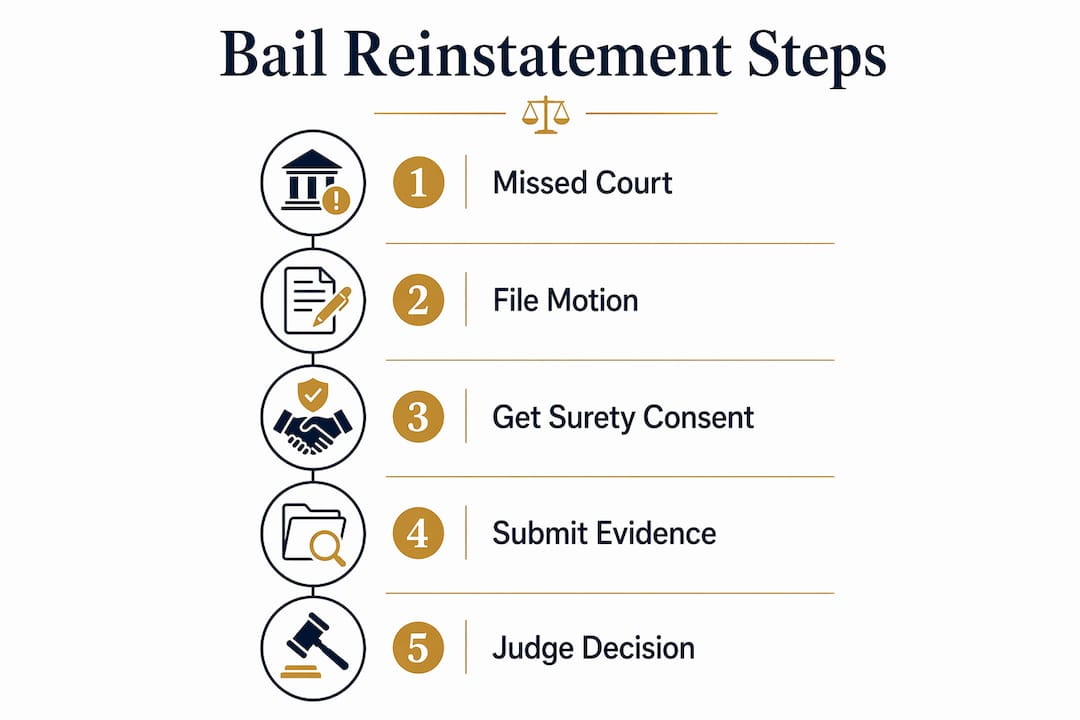
The reinstatement process follows a specific sequence. Skipping any step or missing a deadline can result in automatic denial.
Contact your bail agent immediately. The consent of surety from your bail bond agent is legally required before the court will consider your motion. Without it, the motion fails. Your agent may also charge additional fees for the administrative costs incurred during the forfeiture period.
Gather supporting documentation. Courts require concrete evidence explaining why you violated your bail conditions. Acceptable documentation includes medical records showing a hospitalization, proof of incarceration in another jurisdiction, or a verifiable emergency. Vague explanations do not work.
File a formal motion with the court. Your attorney prepares and files the motion to reinstate bond. The motion must include your case number, the reason for the violation, supporting evidence, and the bail agent’s written consent. The motion is then served on the prosecution.
Attend the reinstatement hearing. The judge reviews the motion, hears arguments from both sides, and decides whether to vacate the forfeiture. Prosecutors frequently oppose reinstatement by citing government costs and disruption caused by your absence.
Confirm the court order in writing. Once the judge signs the reinstatement order, verify with the court clerk that the bench warrant has been officially vacated in the court’s records.
Pro Tip: Never try to explain a missed court date directly to a judge on your own. An attorney filing the motion on your behalf significantly improves your chances by framing the evidence correctly and anticipating the judge’s concerns.
Processing time varies by court calendar and typically ranges from a few days to a couple of weeks. The bench warrant remains active throughout that entire window. You are at risk of arrest until the judge signs the order.
Judges in Ohio do not reinstate bail automatically. They weigh several factors before deciding, and your preparation directly affects the outcome.
Key factors judges consider include:
“Judges are less likely to reinstate bail when violations involve ignoring court orders, new criminal charges, or protective order breaches. Showing changed circumstances, such as steady employment or rehabilitation, gives the court a concrete reason to approve reinstatement.”
Legal representation is not optional here. Criminal defense attorneys who file reinstatement motions know how to present evidence in the format judges expect and how to counter prosecution arguments effectively. Going into this hearing without an attorney is one of the most common and costly mistakes defendants make. You can review common bail process mistakes to avoid compounding the problem.
Filing the motion is only the first step. What you do during the waiting period determines whether you stay safe and whether the reinstatement succeeds.
| Action | Why It Matters |
|---|---|
| Verify bench warrant status with the court clerk | Your bail agent’s records and court records may not match until the judge signs the order |
| Confirm the signed reinstatement order is on file | A verbal approval from the judge is not enough; the written order must be recorded |
| Budget for additional fees | Bail agents may charge administrative fees during the forfeiture period |
| Attend all scheduled hearings | Missing the reinstatement hearing itself triggers automatic denial |
| Avoid any new legal trouble | New charges during the reinstatement process almost guarantee denial |
One critical detail many people miss: even if your bail agent shows the bond as reinstated in their internal system, the bench warrant stays active in court records until a judge signs the formal order. Always verify directly with the court clerk, not just your agent.
Pro Tip: Call the court clerk’s office the day after the judge signs the reinstatement order to confirm the bench warrant has been cleared in the official system. Do not assume the update happens automatically or overnight.
Missing filing deadlines is the fastest way to lose your reinstatement opportunity. Courts treat late filings as automatic denials. Prosecution opposition at the hearing is standard, so your attorney must be prepared to address arguments about the duration of your absence and any costs your absence created.
Bail reinstatement requires a formal court motion, bail agent consent, documented evidence, and a judge’s signed order before a bench warrant is cleared.
| Point | Details |
|---|---|
| Reinstatement is not automatic | You must file a formal motion with supporting evidence; courts do not restore bail on their own. |
| Bail agent consent is required | Without written surety consent, the court will not consider your reinstatement motion. |
| Bench warrant stays active during processing | Verify the signed court order directly with the clerk before assuming you are safe from arrest. |
| Judges weigh government harm | Financial and procedural costs caused by your absence are formal factors in the judge’s decision. |
| Deadlines are strict | A late filing typically results in automatic denial, with no second chance to refile. |
Working in Ohio bail bonds for years, I’ve watched defendants make the same avoidable mistakes over and over. The biggest one is waiting. People assume they have time to figure things out after a missed court date. They don’t. The bench warrant is issued fast, and every day without a filed motion is a day the situation gets harder to reverse.
The second mistake is underestimating the documentation requirement. Judges are not moved by verbal explanations or general hardship stories. They want records. A hospital discharge summary, a dated incarceration document from another county, a letter from an employer. Without that paper trail, even a sympathetic judge has nothing to work with.
What I’ve also seen is that defendants who show up to the reinstatement hearing with evidence of changed behavior, a new job, enrollment in a program, a stable address, get better outcomes. Judges are balancing public safety against fairness. Give them a reason to land on the fairness side.
The role of the prosecutor in these hearings surprises a lot of people. Prosecutors routinely oppose reinstatement and come prepared with cost figures and absence timelines. Understanding how prosecutors operate in bail hearings helps you and your attorney prepare a stronger counter-argument.
My honest advice: get an attorney, get your documents together, and move fast. The reinstatement process is winnable, but only if you treat it with the same seriousness the court does.
— Anthony
Facing bail revocation is stressful, but you do not have to figure it out alone. Caesarbailbonds operates across Ohio with licensed agents available 24 hours a day, 7 days a week, including in Columbus, Cincinnati, Dayton, Akron, and Canton.

Our agents understand Ohio bail procedures and can help you coordinate the consent of surety your attorney needs to file a reinstatement motion. We also provide guidance on next steps, keep you informed throughout the process, and respond fast when time is critical. Whether you need help with an existing bond or are starting from scratch, our 24-hour bail bond services are built for exactly these situations. Reach out to our team now for immediate, dependable support from agents who know Ohio courts.
Bail reinstatement is the court process that restores a revoked bail bond after a defendant misses court or violates release conditions. A judge must sign a formal order before the defendant is legally back on release.
Reinstatement requires a formal motion filed by an attorney, written consent from the bail bond agent, and documented evidence explaining the violation. Courts deny motions that lack any of these elements.
Processing typically takes a few days to a couple of weeks depending on the court’s schedule. The bench warrant remains active the entire time until the judge signs the reinstatement order.
Yes. Judges deny reinstatement when violations involve new criminal charges, a pattern of missed appearances, or when the defendant cannot provide a valid, documented reason for the violation.
Yes. The bail agent’s written consent, called consent of surety, is legally required before the court will consider a reinstatement motion. The agent may also charge additional fees during the forfeiture period.
If you are in need of a bail bonds service in OH, look no further than Caesar Bail Bonds LLC. For a great service in Lorain, Elyria, North Ridgeville, Avon Lake, Oberlin, Sandusky, Vermillion, Toledo, Port Clinton, Greene County, Columbus as well as in the entire state of Ohio call on Caesar Bail Bonds LLC.
Get Quote !
"*" indicates required fields