
Menu

Bail is the court-set monetary amount a defendant must pay to guarantee their appearance at future court dates, while a bond is the financial arrangement used to satisfy that bail requirement, often through a licensed bail bondsman acting as a surety guarantor. The bail vs bond difference comes down to who pays, how much, and whether you get that money back. Understanding this distinction is not just a legal formality. It directly shapes how quickly your loved one gets home and what it costs your family in the long run.
Bail requires you to pay the full court-set amount directly to the court. If the defendant meets all court obligations, the court returns that money, minus minor administrative fees. That makes cash bail a refundable deposit in most cases.
A bail bond works differently. You pay a licensed bondsman a non-refundable premium of 10%–20% of the total bail amount. The bondsman then posts the full bail with the court on the defendant’s behalf. That premium is the bondsman’s service fee. You never get it back, regardless of the case outcome.

The financial gap between these two options is significant. The median money bail in the US is approximately $10,000. Paying cash bail means tying up $10,000 until the case resolves. Using a bondsman means paying $1,000–$2,000 upfront and never recovering it, but keeping the remaining $8,000–$9,000 available for legal fees, living expenses, and other needs.
Bondsmen also frequently require collateral, such as real estate, vehicles, or valuables, to secure the bond. If the defendant fails to appear in court, bail is forfeited entirely. With a bond, the bondsman loses the full bail amount posted and will pursue the defendant and any collateral to recover those losses.
Pro Tip: Before choosing between cash bail and a bond, calculate your total liquid assets. If paying the full bail amount would leave your household without emergency funds, a bail bond is the more practical choice even though it costs more in fees.
| Feature | Cash bail | Bail bond |
|---|---|---|
| Who pays the court | Defendant or family | Licensed bondsman |
| Amount required upfront | 100% of bail | 10%–20% premium |
| Refundable | Yes, if obligations met | No, never |
| Collateral required | No | Often yes |
| Risk if defendant flees | Full bail forfeited | Collateral seized, bondsman pursues defendant |
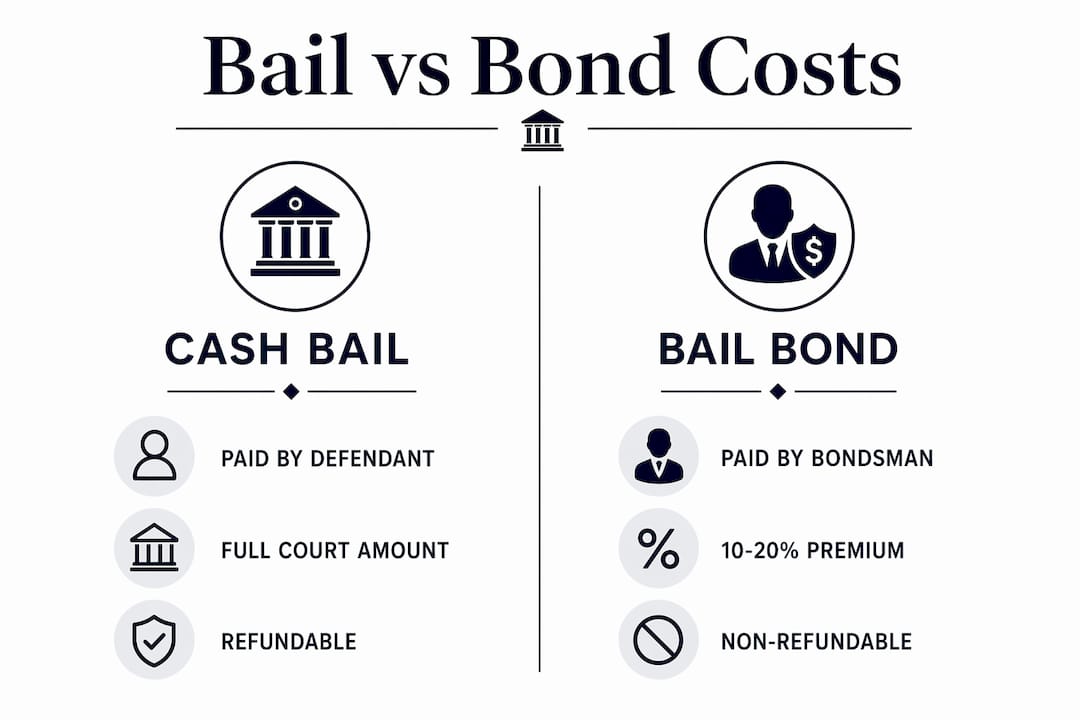
Cash bail creates a two-party agreement. The court sets the bail amount, and the defendant or their family pays it directly. The legal obligation runs between the defendant and the court. No third party carries any liability.
A bail bond creates a three-party contract involving the court, the defendant, and the bondsman. The bondsman acts as a surety, meaning they guarantee the defendant’s appearance to the court. By signing the bond contract, the defendant and their co-signer accept legal and financial obligations to the bondsman, not just to the court.
This three-party structure gives bondsmen significant legal powers that most families do not expect:
Understanding these powers matters before you sign a bond agreement. You are not just helping someone get out of jail. You are accepting shared legal and financial responsibility for that person’s court compliance.
The right choice depends on your household’s financial position and the specifics of the case. Neither option is universally better. Each fits different circumstances.
Choose cash bail when:
Choose a bail bond when:
Legal experts advise that household liquidity is the primary factor in this decision. A bail bond is essentially a loan service. You pay a fee to borrow the bondsman’s financial guarantee. That fee is a real cost, and families often underestimate it when they are under pressure to act fast. The decision is not just about speed. It is about long-term financial impact on your family.
Pro Tip: Ask the bondsman for a full written breakdown of fees, collateral requirements, and co-signer obligations before signing anything. A reputable agent like those at Caesarbailbonds will walk you through every term clearly.
The cash bail system creates outcomes that go far beyond individual cases. Cash bail causes pretrial detention for roughly half a million people in the United States who cannot afford to pay. That means hundreds of thousands of people sit in jail not because they were convicted, but because they lack funds.
The burden falls hardest on specific groups. People of color and low-income defendants face higher bail amounts on average and longer pretrial detention periods. This disparity affects their ability to prepare a defense, maintain employment, and support their families during the legal process.
| Group affected | Documented impact |
|---|---|
| Low-income defendants | Cannot post bail, remain jailed pretrial |
| Defendants of color | Face higher bail amounts on average |
| Families of detained defendants | Loss of income, housing instability |
| Defendants held pretrial | More likely to accept plea deals regardless of guilt |
One in three people arrested in the US is not ultimately convicted, yet many spend days, weeks, or months in pretrial detention because they cannot meet bail. That detention itself worsens legal outcomes. Defendants held pretrial are statistically more likely to accept unfavorable plea agreements simply to end their incarceration.
Bail reform advocates point to personal recognizance release as an alternative. Under personal recognizance, a judge releases a defendant on their written promise to appear, with no money required. This option is available for lower-risk defendants and eliminates the financial barrier entirely. However, it is granted at the court’s discretion and is not available in all cases. Understanding bail bond vs personal recognizance options helps defendants and families ask the right questions at arraignment.
The core bail vs bond difference is this: bail is a refundable court deposit paid directly by the defendant, while a bond is a non-refundable fee paid to a licensed bondsman who guarantees the full bail amount to the court.
| Point | Details |
|---|---|
| Bail is refundable | Cash paid directly to court is returned if all court obligations are met. |
| Bond premiums are not refundable | The 10%–20% fee paid to a bondsman is a service cost, never returned. |
| Three-party bond contracts carry risk | Co-signers accept legal and financial liability alongside the defendant. |
| Liquidity drives the decision | Choose cash bail if funds allow; use a bond when full payment would strain household finances. |
| Pretrial detention has real consequences | Inability to pay bail leads to detention that worsens legal outcomes and financial stability. |
The biggest mistake I see families make is treating the bail vs bond choice as purely a speed problem. They panic, call the first bondsman they find, and sign paperwork without reading the collateral clause. Weeks later, they realize they pledged their car or their home to secure a bond for someone who may not take their court dates seriously.
The second mistake is assuming cash bail is always the safer path. Tying up $10,000 or $50,000 for a case that drags on for 18 months is its own kind of financial damage. That money could cover attorney fees, which directly affect the outcome of the case far more than which release method you chose.
My honest advice: slow down by five minutes before signing anything. Ask the bondsman exactly what happens if the defendant misses a single court date. Ask what collateral they can and cannot seize. Ask whether the co-signer can be released from the agreement if circumstances change. A professional agent will answer every one of those questions without hesitation. If they rush you past those questions, walk away.
The families who navigate this best are the ones who treat it as a financial and legal decision, not just an emotional one. Your loved one’s freedom matters. So does your family’s financial stability. Both deserve careful thought, even under pressure.
— Anthony
When someone you care about is in custody, every hour matters. Caesarbailbonds serves defendants and families across Ohio, including Columbus, Cincinnati, Dayton, Akron, and Canton, with 24/7 mobile bail bond service. Our licensed agents come to you, whether you are at home, at the jail, or anywhere in between.

We handle felony and misdemeanor cases, transfer bail across jurisdictions, and guide you through every step of the process with clear answers and no pressure. If you are weighing your Ohio bail bond options and need a trusted, experienced team on your side, our agents are available right now. You can also connect directly with a licensed agent near you to get started immediately.
Bail is the court-set amount paid directly to secure a defendant’s release, while a bond is a financial guarantee provided by a licensed bondsman who posts the full bail in exchange for a non-refundable fee of 10%–20%.
Cash bail paid directly to the court is refundable once the defendant fulfills all court obligations, though courts may retain minor administrative fees.
The bail is forfeited, the bondsman loses the full amount posted, and the bondsman has the legal right to locate and apprehend the defendant and seize any pledged collateral to recover losses.
The median US bail amount is approximately $10,000, and people of color and low-income defendants face higher bail amounts on average, making pretrial release financially out of reach and increasing the likelihood of prolonged detention.
Personal recognizance release is a court-granted option where a defendant is released on a written promise to appear, with no money required. It is available at the judge’s discretion for lower-risk defendants and eliminates the financial barrier of both cash bail and bond premiums.
If you are in need of a bail bonds service in OH, look no further than Caesar Bail Bonds LLC. For a great service in Lorain, Elyria, North Ridgeville, Avon Lake, Oberlin, Sandusky, Vermillion, Toledo, Port Clinton, Greene County, Columbus as well as in the entire state of Ohio call on Caesar Bail Bonds LLC.
Get Quote !
"*" indicates required fields